

If I Were a Student Again
I’d Do This

Here’s something that took me years to figure out.
Your day job — writing code, shipping features, attending standups — that’s the main quest. It takes you from junior to mid to senior. Maybe even to staff if you’re lucky.
But here’s the problem: just completing the main quest leaves you underleveled for what comes next.
Think about any open-world game you’ve played. Skyrim. Zelda. Whatever.
There’s always a main storyline that takes you from start to finish. But if you ONLY do the main quest and ignore all the side quests, you show up to the final boss at level 20 when everyone else is level 50.
You’re underleveled. Undergeared. Missing skills.
Same thing happens in your career.
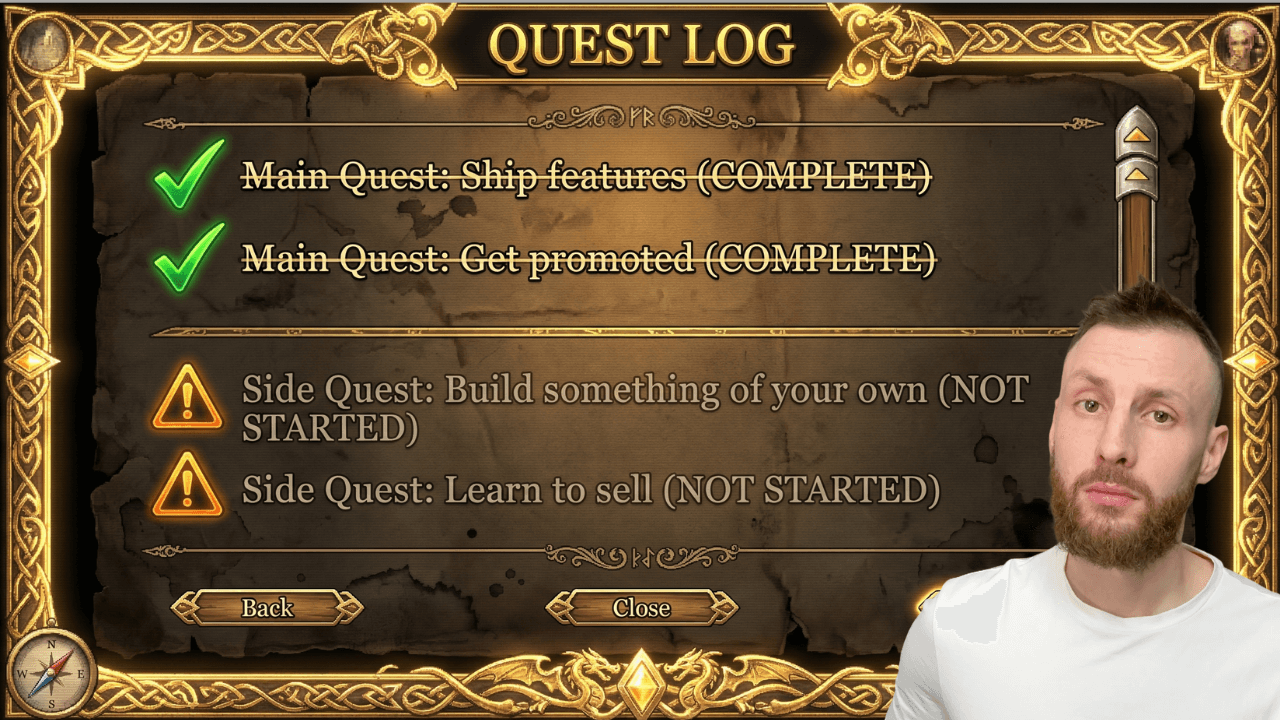
You can spend 5 years doing your engineering job, following the main quest perfectly. Ship features. Get good reviews. Get promoted.
And then one day you want to:
Start your own thing
Land a higher-paying role
Become a tech lead
Have options when the market gets rough
And you realize... you’re underleveled. You have the title but not the skills that actually matter in the real world.
What Actually Matters
Let’s be honest about why we work.
We need money. We want financial security. We want options.
Your engineering skills help you get a job. But they don’t automatically make you valuable in the broader market. Especially now with AI changing everything and layoffs happening left and right.
The engineers who thrive aren’t just good at their main job. They’ve leveled up skills that are valuable beyond their current role.
High-Income Skills vs. Nice-to-Have Skills
Not all skills are equal. Some are what I call “high-income skills” — they directly help you make money or make others money.
High-income skills for engineers:
Understanding the business side (not just the code)
Communication that influences decisions
Building things end-to-end (not just your piece)
Sales and persuasion (yes, even for engineers)
Writing that gets attention
Leading people and projects
Using AI to 10x your output
Nice-to-have skills (but won’t pay your bills):
Getting really good at a niche framework nobody uses
Perfecting your neovim config
Collecting certifications
Being the “technically correct” person in code reviews
I’m not saying don’t have hobbies. Have hobbies. Learn guitar. Play chess. Go to the gym.
But don’t confuse hobbies with career investments.
The Side Quests That Actually Pay Off
Here’s what I’d do if I were an engineer trying to level up:
1. Build something that makes money (even $100)
Doesn’t matter what. A tiny SaaS. A paid newsletter. A course. Freelance work.
The skill of turning code into cash is completely different from the skill of writing code at a job. Most engineers never learn it.
You’ll learn more about business, marketing, and what people actually pay for in one side project than in 5 years of corporate work.
2. Get good at writing and communication
Most engineers underinvest here.
The person who can explain complex things simply, write proposals that get approved, and communicate up the chain — they get promoted. They get noticed. They get opportunities.
Start a blog. Write on LinkedIn. Document your work publicly. It compounds.
3. Learn the business side of your company
How does your company make money? What metrics matter? Who are the customers? Why do they pay?
Engineers who understand this stuff become 10x more valuable. They make better technical decisions. They know what to prioritize. They speak the language of people who control budgets.
4. Build relationships outside your immediate team
Your network is an asset.
Not “networking” in the gross LinkedIn way. Just... know people. Help people. Stay in touch with former colleagues. Go to meetups. Be known for something.
When layoffs happen or you want to switch jobs, this is what saves you.
5. Ship side projects that showcase your skills
A GitHub full of half-finished projects means nothing.
One finished thing that people actually use? That’s proof you can ship. That’s leverage in job interviews. That’s a foundation for something bigger.
Here’s what nobody tells you:
Your employer is paying you to solve THEIR problems. Not to develop YOU.
If you spend all your energy on the main quest — your job — you’re building someone else’s asset. Their product. Their company. Their wealth.
Your skills? Those are YOUR asset. But only if you actually develop them.
The engineers who end up stuck, underpaid, or laid off with no options? They’re the ones who thought doing their job well was enough.
It’s not.
Practical Next Steps
If this resonates, here’s what to do this week:
Audit your time. Where is it going? All main quest, no side quests?
Pick ONE high-income skill to develop. Not five. One. Maybe it’s writing. Maybe it’s understanding your company’s business. Maybe it’s building something on the side.
Block 5 hours a week for your side quest. Protect it like a meeting. This is your investment in yourself.
Set a 90-day goal. Not vague “get better at X.” Something concrete. “Publish 12 articles.” “Launch a landing page.” “Have coffee chats with 10 people in leadership roles.”
Track it. What gets measured gets done.
You have more free time and energy than you think. You’re just spending it on the wrong things.
Five years from now, you can be the engineer who’s trapped in their job with no options. Or you can be the one who has skills, network, and maybe even a side income that gives you freedom.
The difference? Side quests.
P.S. You don't have to figure it out alone.
👉 Join my community